Shop Products

HOW TO MEASURE A GAS STRUT

Gas struts and gas springs are the same product — the terms are used interchangeably. This guide covers sizing for both.

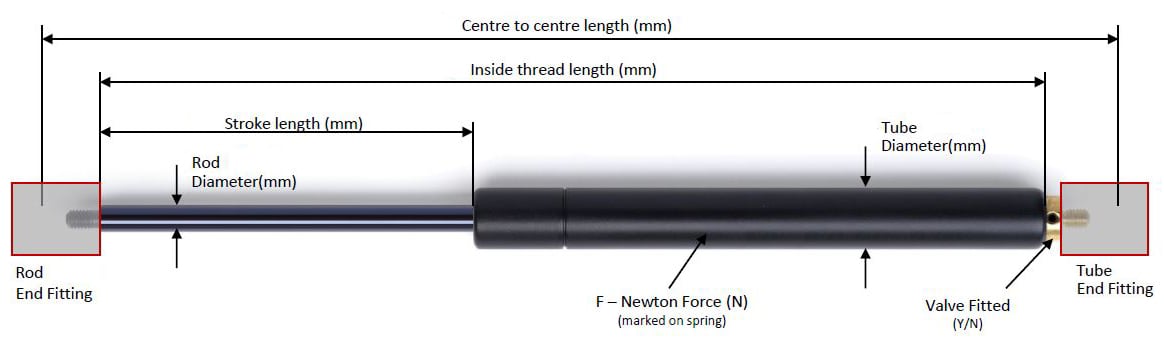
To measure a gas strut correctly, you need four key dimensions. Measure with the strut fully extended and removed from the application where possible. 

 If you already know your measurements, jump straight to the Gas Strut Finder to find your matching part and buy online with next day delivery. 

1. Extended length

The total length of the strut when fully open - measured from the centre of one end fitting to the centre of the other.

This is the measurement most listed on product pages.

2. Stroke length

How far the rod travels from fully closed to fully open. Usually around 55–60% of the extended length for standard struts.

Compressed length = extended length minus stroke.

3. Rod diameter

The diameter of the inner rod in millimetres. Common sizes are 6mm, 8mm, 10mm and 14mm.

This forms part of the size code — see the chart below.

4. Force rating

The output force in Newtons (N), usually stamped or printed on the body of the strut.

Vari-Lift struts are supplied at max force and can be adjusted down.

How to Measure a Gas Strut Drawing

Understanding gas strut size codes

The two numbers in the product code, e.g. 6-15 refer to the rod diameter and tube diameter in mm. The first number is the rod and the second is the tube body.

6-15 Range
6mm rod · 15mm tube
Light d
uty

8-18 Range
8mm rod · 18mm tube
Light–medium
duty

10-23 Range
10mm rod · 23mm tube
Light d
uty

14-28 Range
14mm rod · 28mm tube
Heavy duty 

GAS strut and gas spring size chart

Use the tables below to match your application's requirements to the correct gas strut size. First, identify the strut size by rod and tube diameter, then check that the force range is appropriate for your lid weight.

Gas strut size codes: rod diameter, tube diameter and typical applications

Size code

Rod diameter

Tube diameter

Duty

Typical applications

6-15

6mm

15mm

Light

Small cabinet doors, tool storage lids, small hatches

8-18

8mm

18mm

Light–medium

Campervans, furniture lids, motorbike panniers, garden storage boxes

10-23

10mm

23mm

Medium

Car bonnets, industrial access panels, tractor cab windows

14-28

14mm

28mm

Heavy

Heavy machinery covers, large industrial hatches and agricultural equipment

Gas strut size chart: lid weight vs recommended strut size

Based on two struts supporting the lid. Weights are approximate — always allow for hinge position and lid geometry. Select force in 10 Newton intervals.

Lid weight (kg) Approx. force per strut (N) Recommended size Notes

Up to 3 kg

50–100 N

6-15

Light-duty only; check mounting clearance

3–6 kg

100–200 N

6-15 or 8-18

Consider 8-18 for longer stroke requirements

6–10 kg

200–350 N

8-18

Most common size for DIY and van conversion use

10–18 kg

350–600 N

8-18 or 10-23

Step up to 10-23 for higher force or longer stroke

18–30 kg

600–900 N

10-23

Suitable for car bonnets and medium industrial lids

30–55 kg

900–1500 N

10-23 or 14-28

Use 14-28 where higher rigidity is needed

55 kg+

1500 N+

14-28 or custom

Contact us to discuss your application

Force range by gas strut size

Force range is determined by allowable pressure and rod buckling load. All adjustable variable force struts are supplied at maximum force and can be adjusted to your specific requirement.

Size code

Minimum force

Maximum force

Force increments

6-15

50 N

400 N

10 N intervals

8-18

100 N

650 N

10 N intervals

10-23

150 N

1200 N

10 N intervals

14-28

300 N

2500 N

10 N intervals


Found your measurements? Use our Gas Strut Finder below 

Gas Strut Finder

Find Your Replacement Gas Strut

Enter the key dimensions from your existing strut to find matching stocked parts available for next day delivery. Rod diameter is selected first — compatible tube diameters are then shown automatically.

Measure these values directly from your existing gas strut. Use the tolerance fields if you can accept a close match rather than an exact size.

Start here — this controls which tube diameters are shown below.
Auto-filtered based on your rod diameter selection.
The distance the rod travels from fully compressed to fully extended.
Enter 0 for exact match. Increase to allow nearby sizes.
The total length of the strut when fully extended, tip to tip.
Enter 0 for exact match. Increase to allow nearby sizes.

Force is optional — leave it blank to see all dimension matches. Material selection will filter to Black Nitrider or Stainless Steel only; choose Show both to see all stocked options side by side.

Leave blank to return all force ratings that match your dimensions.
Use 0 for exact. Increase (e.g. 50) to include nearby force ratings.
Stainless Steel suits outdoor, marine, and food-contact environments.
All results are stocked items. Order by 3pm for next day delivery. Free delivery on orders over £75+VAT.
Part number Finish Rod Ø Tube Ø Stroke Extended length Compressed length Force (N) Buy
Complete steps 1 and 2 to see your matches.

All dimensions (rod Ø, tube Ø, stroke, extended length, compressed length) are in millimetres.

The best dimension match is highlighted. Part numbers link directly to the product page. If you need help confirming the right strut for your application, contact our team — we're happy to help.

Browse all gas struts

Need a custom size or complex application?

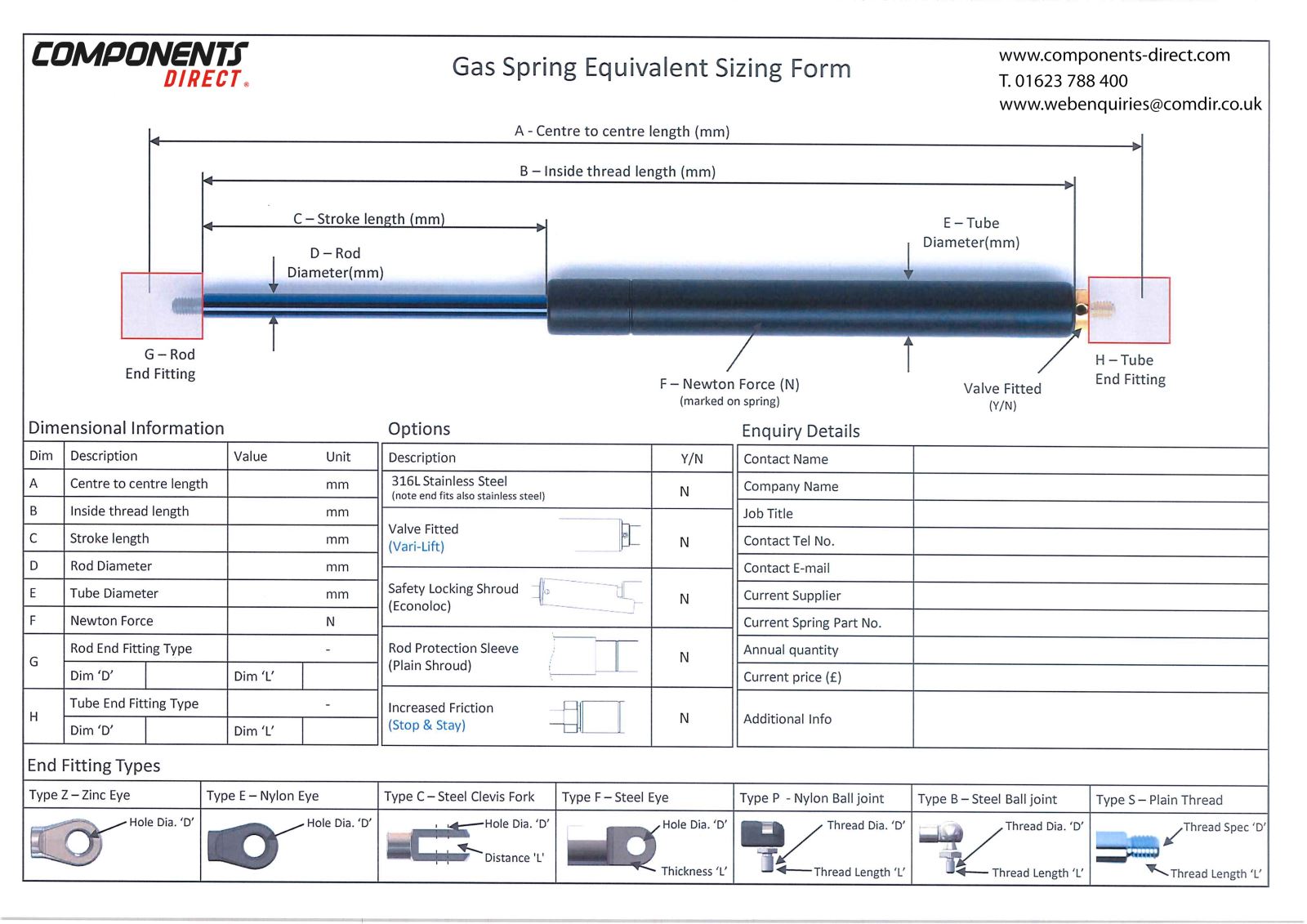
Download and complete our Gas Strut Sizing Questionnaire, then return it to our technical team. We'll recommend the correct strut for your specific setup.

↓ Download Gas Strut Sizing Form (PDF)   or call us on 01623 788 400 or email: webenquiries@comdir.co.uk

Gas Strut Equivalent Sizing Chart

Replacing an existing gas strut

If you're replacing a gas strut that's failed or lost pressure, follow these steps to identify a direct replacement.

  1. Measure the extended length and stroke — Measure the old strut fully extended, centre of end fitting to centre of end fitting. Note the stroke length (how far the rod travels). If the old strut is collapsed, compressed length = extended length minus stroke.

  2. Check the force rating — Look for a label or stamp on the body of the strut. It will show the force in Newtons (e.g. 500N). If the label is gone, use the lid weight table above to estimate the required force.

  3. Measure the rod and tube diameter — Use calipers for accuracy. Match to the size code table above (e.g. 8mm rod, 18mm tube = size code 8-18).

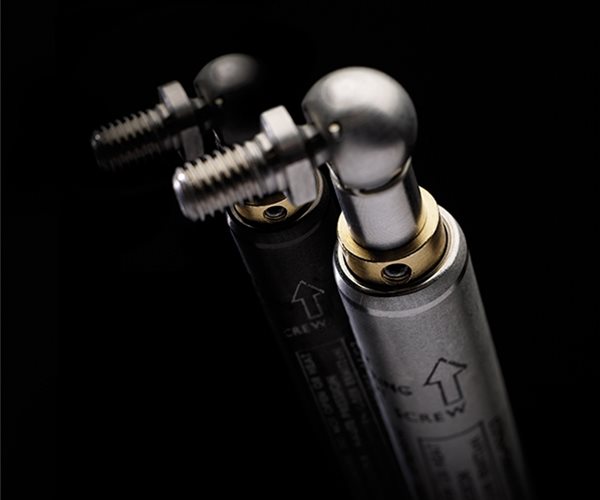
  4. Check the end fittings — The most common types are ball joints (clevis) and eyelets. Ensure the thread size and fitting type match your existing mounting brackets. View end fitting options →

  5. Weigh the lid — If unsure about the force rating, weigh the lid to be supported (in kg) and cross-reference with Table 2 above. Allow for hinge placement — mounting closer to the hinge reduces the force required.

Other gas strut sizing considerations

Mounting position and angle

Mounting the strut closer to the hinge reduces the force required. The angle of operation affects how the strut extends — ensure it doesn't overextend or bind at the limits of travel.

Number of struts

Most applications use two struts, one on each side. The force tables above assume two struts. If using a single strut, double the force per strut required.

Temperature and environment

Gas struts lose a small amount of force in cold conditions. For outdoor or refrigerated applications, account for this or consider stainless steel struts for corrosive environments.

Opening force feel

A strut with too much force will make the lid feel heavy to close; too little and it won't hold open. variable force struts allow adjustment after fitting — ideal if you're unsure about the exact force needed.

Common Applications for Gas Struts

  • Cabinets and Furniture: Soft-close doors and hatches.

  • Car Bonnets and Boot Lids: Safe and secure opening and closing.

  • Motorbike Panniers: To hold the lid open securely while accessing storage.

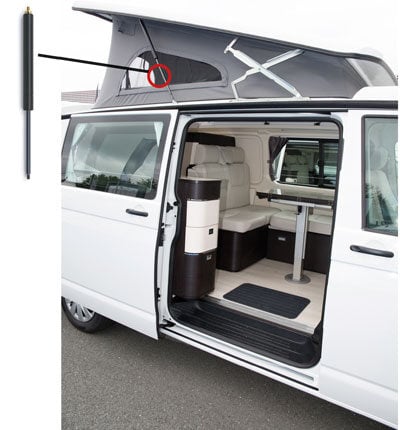
  • Campervans: Pop-top roofs or storage compartments.

  • Industrial Equipment: Access panels and machine covers.

  • Bird Hides and Observation Points: Gas struts can lift and hold lids or shutters open, making them silent and easy to use for nature enthusiasts.

  • Animal Enclosures: Used for hatches or lids in zoos, farms and wildlife parks.

  • Garden Storage Boxes: Gas struts ensure smooth operation of heavy lids for outdoor storage

  • Toolboxes and Workstations: Lid support for safe and easy access.

  • Medical Equipment: Used for adjustable hospital beds, trolleys and operating tables.

  • Tractor Cabs: Support for windows or access panels.

  • Aviation Applications: Access panels or storage compartments in small aircraft.

Campervan-Gas-Struts

Browse our gas strut range

Available in stock for online ordering with next-day delivery.

Shop gas struts →

FREQUENTLY ASKED QUESTIONS

How do I measure a gas strut that's still fitted to my application?

Open the lid or hatch to fully extend the strut. Measure from the centre of the end fitting at the body end to the centre of the end fitting at the rod end - this is the extended length.

For the stroke, measure the length of exposed rod (the shiny section visible outside the body). If you can't easily access the fittings, measure body-to-body and add roughly 10–15mm per end fitting to account for the mounting centres.

What does the size code on a gas strut mean? (e.g. 6-15, 8-18)

The two numbers refer to the rod diameter and tube diameter in millimetres. So 8-18 means an 8mm rod inside an 18mm tube.

The rod diameter affects the maximum force the strut can handle before buckling, and the tube diameter determines the overall body size.

Common sizes are 6-15 (light duty), 8-18 (light-medium), 10-23 (medium) and 14-28 (heavy).

What is stroke length on a gas strut?

Stroke length is the distance the rod travels from fully compressed (closed) to fully extended (open). It determines how far your lid or hatch can open. For most standard gas struts, stroke length is roughly 55–60% of the extended length. Compressed length = extended length minus stroke length.

How do I calculate what force gas strut I need?

A useful starting point is: weigh the lid in kg, multiply by 10 (to approximate Newtons), then divide by two if using two struts. However, this doesn't account for hinge position or lid geometry. For a more accurate calculation, use our Gas Strut Sizing Form or contact our technical team. Our Vari-Lift struts are supplied at maximum force and can be adjusted down after fitting, which takes the guesswork out of it.

Can I replace my gas strut with a different size?

Yes, provided the force rating and mounting points are compatible. The end fittings (ball joints, eyelets) must suit your existing brackets, and the compressed length must fit within your available space when the lid is closed. Matching the original extended length and stroke as closely as possible is recommended. If switching to a different size code (e.g. from 6-15 to 8-18), check that the body diameter will clear any surrounding panels or frames.

What is the difference between a Vari-Lift and a standard gas strut?

A standard gas strut is supplied at a fixed force and cannot be adjusted. A Vari-Lift gas strut is supplied at maximum force and can be adjusted downwards on-site using a release tool - allowing you to dial in the exact force your application needs without ordering multiple struts. All our standard gas struts and Stainless Steel ranges are Vari-Lift.

What is the difference between a gas strut and a gas spring?

They are the same product. "Gas strut" is the more common term in UK automotive, DIY and trade contexts. "Gas spring" is widely used in industrial, engineering and international applications. Both terms describe a sealed cylinder containing compressed nitrogen gas and oil, which provides a controlled force to support or lift a load.

What happens if I use the wrong size gas strut?

If the force is too high, the lid will be very hard to close and may place excessive stress on hinges and mountings. If the force is too low, the strut won't hold the lid open,  particularly dangerous for heavy lids. Incorrect extended or stroke length can cause the strut to bind, overextend, or fail to fit within the available space when closed.

SPEAK TO OUR EXPERTS

To speak to one of our experts about Gas Struts,  please submit the form below. Our team is always happy to help.